What does POSIWID mean?
POSIWID — “The purpose of a system is what it does.” Judge a system by its behavior, not its mission statement (Stafford Beer).
Systems thinking for the AI-native world — taught as a discipline, with receipts.
This sky is Chapter 1, running live. Move through the flock · click for a gust · hold to gather it — or drop a storm on it below ↓
Chapter 1, running live. Drop the storm; watch which one survives. Then ask which one is your company — find out in 2 minutes →
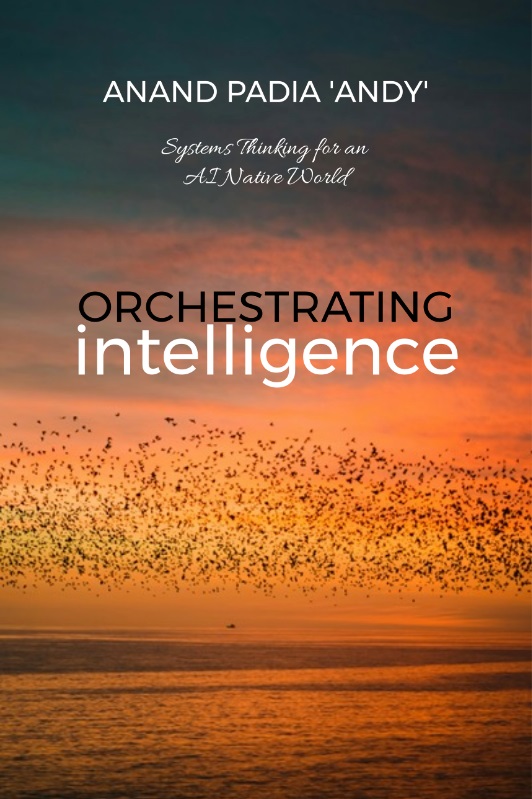
 Hover to turn it over
Enterprises rarely fail at AI because the models are wrong. They fail because AI made execution cheap while leaving the real bottleneck untouched — the ability to see the system the work runs through. This book teaches that seeing as a discipline: the Watch and the Murmuration, the five-layer Orchestration Stack, the Loop Map, the Five Stages, and a scorecard honest enough to light up red.
Told through three colleagues: Ravi, a COO discovering he is his company’s bottleneck; Maya, an engineer whose twenty-year craft just became free; and Diane, a CFO who refuses to believe a slide.
Every real case is sourced; every invented illustration is labeled. Southwest’s meltdown, Zillow’s half-billion-dollar algorithm, Knight Capital’s forty-five minutes — receipts, not anecdotes.
Thirty-five chapters, thirty-five tools. The ones marked live run today, free, no login. The rest say in build because they are — each chapter page tells you what’s coming and takes your email for the day it ships.
Every rung is complete on its own. Each one makes the next unnecessary — until you want it.
Climb alone
Self-serve, tonight. Rungs 1–2.
See your system tonight: the interactive Loop Map, the Scorecard templates, and the digital Field Workbook.
Coming soonEverything the kit has, plus the 90-minute recorded masterclass and the Orchestrator’s Audit toolkit. Named for the room where the book’s cast does its thinking.
Coming soonClimb together
A voice in the room. Rungs 3–4.
Two hours, one-on-one. Bring one workflow; Andy sits in your second chair.
Coming soonFounding prices end when they end — once, and they don’t come back down. Everything paid carries a 30-day money-back guarantee: one email, no forms. No countdown timers, ever.
The community is where the frameworks meet actual companies: people share their audits, compare scorecards that lit up red, and work through the awkward middle of a Sprint. Once a month there’s a live call — Run It Monday — where we take one member’s real workflow and orchestrate it together. The free tier is genuinely free and genuinely useful; that’s the point of it.
Free, no gate, no email — bookmark it. A sample:
POSIWID — “The purpose of a system is what it does.” Judge a system by its behavior, not its mission statement (Stafford Beer).
Blast radius — How far the damage spreads when an AI action goes wrong. Good guardrails shrink it.
Knowledge loop — A cycle in which an action’s outcome feeds back into context so the system improves instead of repeating. Layer 4 of the Stack.
Shadow AI — The unsanctioned AI tools your people already use in the dark. The connections grow faster than the nodes; an amnesty beats an audit.
Leverage point — A place in a system where a small change produces a large effect. Usually a rule or incentive, rarely a number or more effort.
One-way / two-way doors — Bezos’s test: can the decision be walked back? Two-way doors are the machine’s to take. One-way doors stay yours.

Orchestrating Intelligence is a book and practical toolkit for leaders building AI-native enterprises. It focuses on the systems, guardrails, operating models, and measurements that make AI deployments survive contact with reality.
It is for executives, transformation leaders, architects, product leaders, and operators responsible for turning enterprise AI pilots into reliable business systems.
The five-layer Orchestration Stack is a model for diagnosing enterprise AI systems across systems thinking, context, guardrails, knowledge loops, and automation. The layers help leaders find where a promising AI initiative is leaking value.
The AI-Native Maturity Assessment, Orchestrator’s Scorecard, Enterprise AI Field Guide, chapter tools, and downloadable Field Workbook are available from the site.
Anand “Andy” Padia wrote Orchestrating Intelligence. He is an enterprise technology and AI executive with more than two decades of experience building banking platforms and governed AI systems.
A single idea, applied to something real — plus tools as they go live and chapters as they ship. Nothing that wastes your attention.
No hype, no drip sequence. Unsubscribe any time.